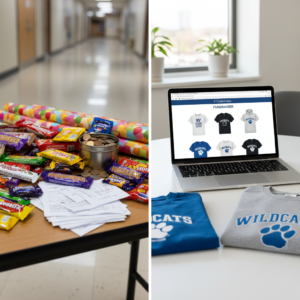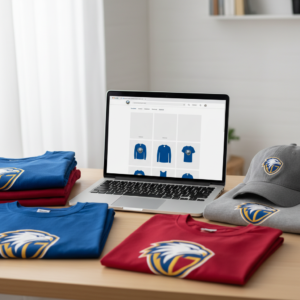
Every school faces the same question when they start selling merchandise. Should you order in bulk and hope you sell out, or should you print each item only after someone buys it? The answer depends on your cash position, your risk tolerance, your storage space, and your fundraising timeline. This guide breaks down both models without bias so you can make the right choice for your specific situation. And if you discover that on-demand fits your needs, you will understand exactly why the Varsity Vault fundraising partnership model is built around it.
How Bulk Ordering Works for Schools
Bulk ordering is the traditional model. You choose your products, submit your designs, and pay for a predetermined quantity upfront. The printer produces everything at once and ships you a box. You store the inventory, handle sales, manage fulfillment, and keep whatever is left over.
This model has one clear advantage: unit cost. When you order fifty or one hundred shirts at once, the price per shirt drops significantly. Screen printing becomes economical at scale, and you can pocket a larger margin on each sale if you sell out. For schools with predictable demand and available capital, that lower unit cost is appealing.
But the model also carries substantial risk. If you order two hundred shirts and only sell ninety, you are stuck with one hundred and ten pieces of unsold inventory. That leftover stock represents wasted money, wasted storage space, and a fundraising shortfall. Many schools have experienced this exact scenario. The excitement of a big order gives way to the reality of a garage full of boxes.
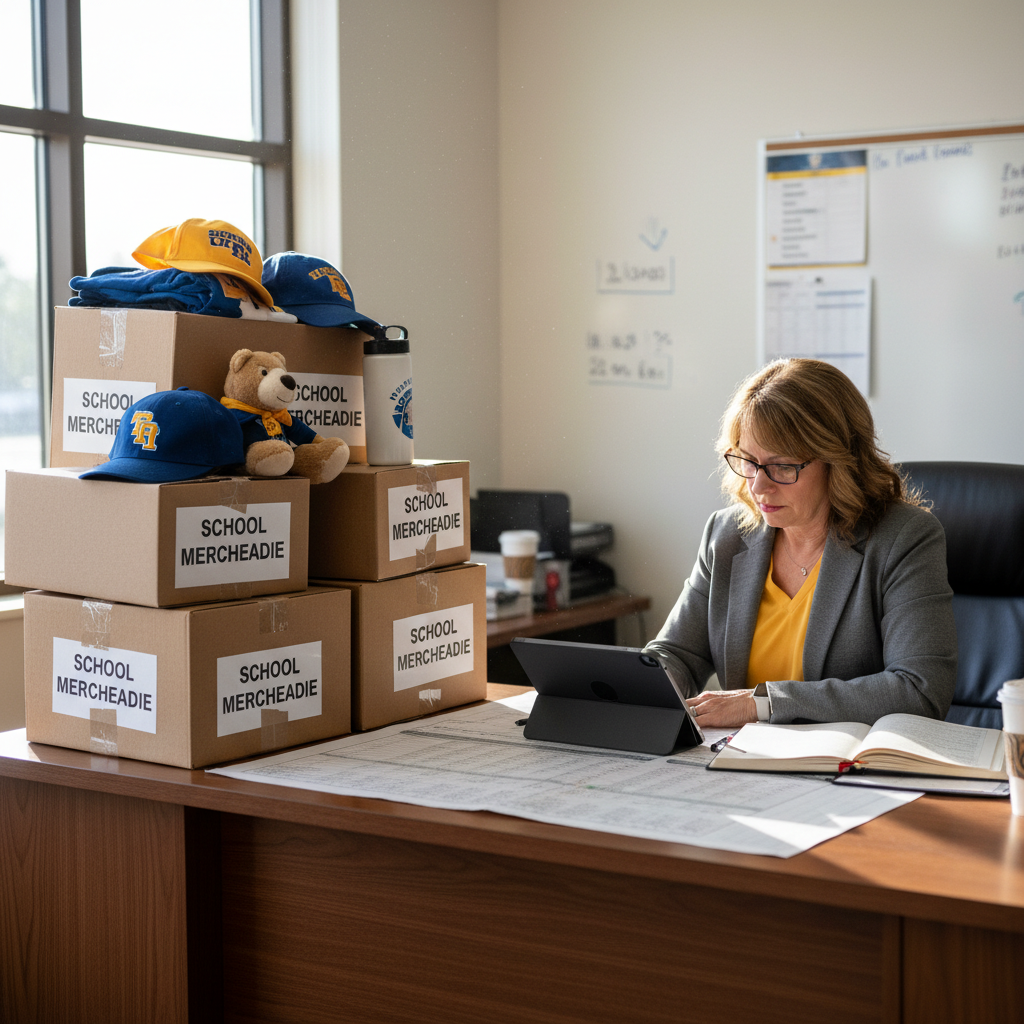
Bulk ordering also demands logistics. Somebody has to receive the shipment. Somebody has to sort sizes. Somebody has to be available for parents who want to buy after school or during events. If your PTA is already stretched thin, adding warehouse duties to the volunteer list is a significant burden.
How On-Demand Printing Works for Schools
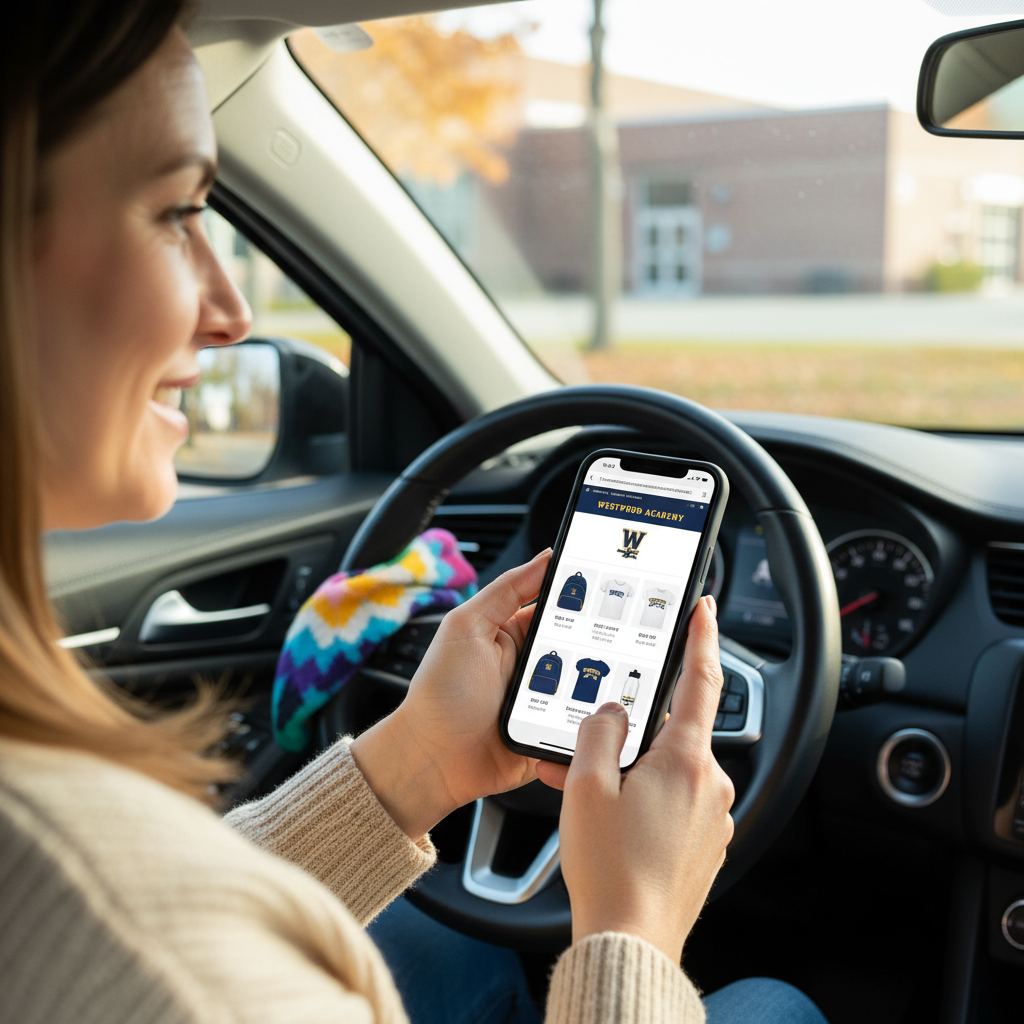
On-demand printing flips the sequence. You create a digital storefront with product listings and mockups. Parents and students browse, select their sizes, and pay online. Only then does the item get printed, packed, and shipped directly to the buyer. The school never touches inventory.
The unit cost per item is higher than bulk screen printing because each piece is produced individually. That is a real tradeoff. However, the total financial risk is zero. You do not spend a dollar before you earn a dollar. If a design flops, you lose nothing but time. If a design sells well, you scale instantly without reordering.
This model also removes the administrative overhead that burns out parent volunteers. There is no inventory to store. There are no size sorting sessions. There are no boxes to load into cars for distribution. The Varsity Vault partnership model handles production, shipping, and customer service so your team can focus on promotion and community building.
A Direct Comparison
| Factor | Bulk Orders | On-Demand |
|---|---|---|
| Upfront cost | High. You pay before selling anything. | None. You pay nothing until a sale occurs. |
| Unit cost | Lower at high volumes. | Higher per item, but no waste. |
| Inventory risk | High. Unsold stock is your loss. | Zero. Only ordered items are produced. |
| Storage needs | Requires physical space for boxes. | No storage required. |
| Fulfillment labor | Handled by school volunteers or staff. | Handled by the printing partner. |
| Scalability | Limited by pre-ordered quantity. | Unlimited. Sell one or one thousand. |
| Design flexibility | Locked in once ordered. Changes cost extra. | Easy to add, remove, or update designs anytime. |
| Speed to launch | Slow. Production and shipping take weeks. | Fast. Store can be live in days. |
When Bulk Ordering Is the Better Choice
Despite its risks, bulk ordering still makes sense in specific situations. If you are selling at a single large event with guaranteed foot traffic, like a homecoming game or graduation ceremony, and you have reliable data about how many people attend, bulk can work. You know the audience is captive and the timeline is fixed.
Bulk ordering also works when you have a committed buyer before you place the order. If the football team needs jerseys and you know exactly how many players need them, ordering in bulk is efficient and cost-effective. The same applies to uniform orders, club shirts with fixed rosters, or staff apparel with known headcounts.
If your school has ample storage space, strong volunteer capacity, and cash reserves that can absorb unsold inventory, bulk ordering may be worth considering. But be honest about those conditions. Most schools overestimate their storage and underestimate their volunteer burnout.
When On-Demand Is the Clear Winner
On-demand printing dominates in almost every other scenario. If you are running a general school merch store fundraiser with open sales to the entire community, you cannot predict demand accurately enough to justify bulk risk. If you are testing new designs, on-demand lets you experiment without committing capital. If you are running a time-sensitive campaign before a specific event, the faster launch timeline gives you a critical advantage.
Schools with limited storage should default to on-demand. Schools with small or overworked volunteer bases should default to on-demand. Schools that need to launch quickly should default to on-demand. And schools that want to offer personalized items, like names or numbers, have no practical bulk option because each piece is unique.
The PTO Today resource library notes that parent volunteer capacity is the single most common constraint on school fundraising success. Removing fulfillment work from the volunteer pipeline is often more valuable than the per-unit savings that bulk ordering provides.
The Hidden Costs of Bulk That Schools Overlook
When schools compare bulk and on-demand, they usually look only at the per-shirt price. That is an incomplete picture. Bulk orders carry hidden costs that erode savings quickly.
First, there is the cost of capital tied up in inventory. Money spent on shirts that sit in a closet for three months is money that cannot be used for other needs. Second, there is the labor cost of sorting, storing, and distributing. Even if volunteers are unpaid, their time has value, and burnout has consequences. Third, there is the cost of unsold inventory. A shirt that cost you six dollars and never sells is a six-dollar loss, not a neutral event.
When you add these hidden costs to the balance sheet, the effective cost gap between bulk and on-demand shrinks dramatically. In many cases, on-demand becomes the cheaper option once risk and labor are properly accounted for.
Research from the Council for Advancement and Support of Education consistently shows that educational institutions underestimate the total cost of ownership for inventory-based programs because they fail to factor in volunteer time and storage overhead.
How the Fundraising Partnership Model Removes the Decision Entirely
The Varsity Vault fundraising partnership model is designed for schools that want the benefits of merchandise sales without the burdens of either model’s drawbacks. Because every item is produced on demand, you get zero inventory risk and zero storage needs. Because we handle fulfillment, you get zero volunteer burnout from packaging and shipping. Because our platform is built for schools, you get a fast launch without custom development.
The tradeoff is a slightly higher unit cost than bulk screen printing. But that cost is borne by the buyer, not by your school. Your commission is locked in regardless of how many items sell. If you sell one shirt, you earn a commission. If you sell five hundred, you earn five hundred commissions. There is no break-even point to hit. There is no inventory to clear. There is only revenue.
This structural difference changes how schools think about their stores. Instead of treating merchandise as a gamble on demand, you treat it as a reliable revenue stream. That mental shift is what allows schools to run campaigns confidently, launch repeatedly throughout the year, and build a culture of consistent support rather than one-off events.
Making the Right Call for Your Next Campaign
If you are still unsure which model fits your situation, answer three questions. Do you know your exact demand before you order? Do you have space to store whatever does not sell? Do you have volunteers willing to handle distribution? If the answer to any of those questions is no, on-demand is the safer path.
If the answer to all three is yes, and you are ordering for a fixed group like a sports team or staff body, bulk may save you money. Just be sure to calculate the true cost, including storage, labor, and the financial hit from any unsold items.
For most schools running community-wide custom school apparel fundraising, the math points clearly to on-demand. The reduced risk, faster launch, and eliminated logistics outweigh the per-unit savings of bulk ordering. Your time and energy are better spent promoting the store and engaging your community than managing boxes in a supply closet.
Hybrid Approaches: Getting the Best of Both Worlds
Some schools use a hybrid strategy. They bulk order core items with guaranteed demand, like team uniforms or staff polos, while running an on-demand store for everything else. This lets them capture bulk savings where demand is predictable without taking risks on experimental designs.
If you choose this path, keep the two streams separate in your accounting. Bulk orders require upfront cash and carry inventory risk. On-demand orders require no cash and carry no risk. Mixing the two in one budget line creates confusion and makes it harder to evaluate what is actually working.
The hybrid model works best for established programs with stable needs and an existing volunteer infrastructure. New programs or schools testing merchandise for the first time should almost always start with on-demand. Once you have data, you can introduce bulk ordering strategically.
Environmental and Practical Considerations
Waste is another factor that schools increasingly weigh in this decision. Bulk orders that result in unsold inventory often end up in landfills or storage closets. On-demand production eliminates that waste entirely because every item already has a buyer. For schools with environmental commitments or sustainability goals, this distinction matters.
There is also the practical matter of sizing. Bulk orders require you to guess the size distribution of your community. You might order too many smalls and not enough extra-larges. On-demand lets each buyer select their exact size, which reduces fit complaints and exchange requests. That accuracy improves customer satisfaction and reduces the administrative work of handling swaps.
Finally, consider the speed of design updates. If your mascot changes or your school rebrands, bulk inventory becomes obsolete immediately. On-demand stores can be updated in minutes. That flexibility protects your investment in the store itself and ensures that your community always sees current branding.
Frequently Asked Questions
Is on-demand printing lower quality than bulk screen printing?
Modern on-demand printing uses direct-to-garment technology that produces durable, vibrant prints comparable to screen printing for most designs. For very large solid-color graphics, screen printing still has an edge, but for the detailed designs most schools use, quality differences are negligible.
How long does on-demand fulfillment take?
Most orders ship within three to five business days after purchase. Buyers receive tracking information automatically. Schools do not need to follow up or coordinate delivery.
Can we switch from bulk to on-demand mid-year?
Yes. Many schools start with bulk orders for specific teams and then add an on-demand store for general community sales. The two models can coexist.
Does on-demand limit the types of products we can offer?
On-demand catalogs are extensive and include shirts, hoodies, hats, bags, blankets, decals, and more. While bulk orders can access some specialty items at lower cost, the on-demand range covers the products that schools actually sell.
What happens if a buyer wants a refund or exchange?
Under the Varsity Vault partnership model, customer service including returns and exchanges is handled by the fulfillment partner. Your school staff is not involved in resolving shipping errors or sizing issues.
Are there regulations we should know about when choosing a fundraising model?
Yes. The National Association of State Boards of Education provides guidance on school district procurement and fundraising policies that may affect your choice of vendor and revenue handling.