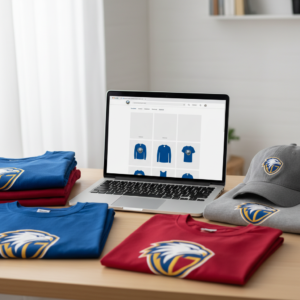
Your booster club has a decision to make. You can stick with the candy bars and car washes that you’ve always done, or you can try merchandise-based fundraising. Leadership is asking about ROI. Parents are asking why you’re still selling chocolate. And your volunteers are exhausted from running events.
This analysis breaks down the real return on investment for different fundraising approaches so you can make an informed decision. But there’s a bigger question beneath the numbers: do you want to go it alone, or do you want a partner who shares the risk and handles the logistics? Traditional fundraising puts every burden on your volunteers — buying inventory, managing orders, coordinating events. A fundraising partner flips that model. They handle the operations so your team can focus on what they do best: promoting your program and engaging your community.
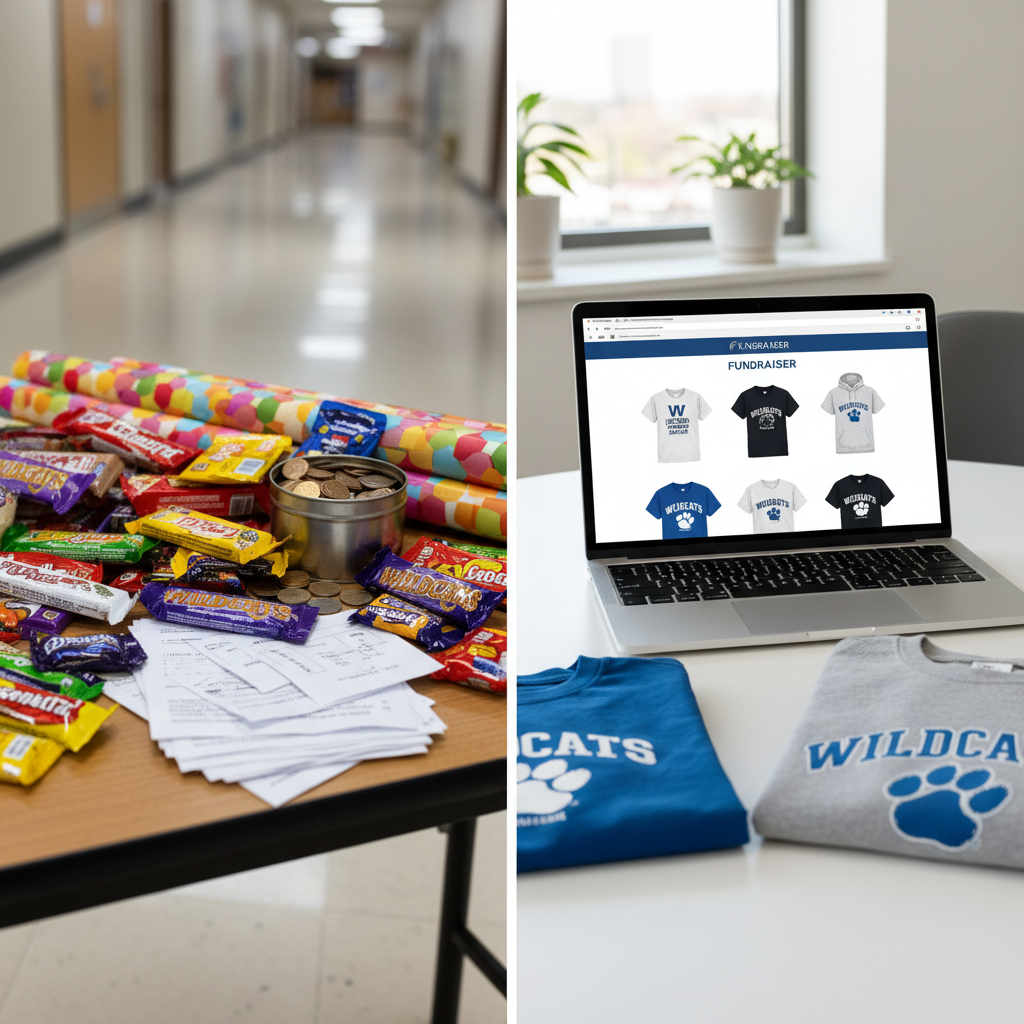
What We’re Measuring
Before comparing approaches, define what ROI means in this context:
- Gross revenue — Total dollars raised before any costs
- Net revenue — Revenue minus all expenses (products, labor, materials)
- Time investment — Hours volunteers spend on fundraising activities
- Sustainability — Can this approach scale without increasing volunteer burden
- Risk — Financial exposure if items don’t sell or events fail
All of these factors matter. A fundraiser that nets $5,000 but requires 200 volunteer hours isn’t necessarily better than one that nets $3,000 for 20 hours of work.
Traditional Fundraising Approaches
Candy and Food Sales
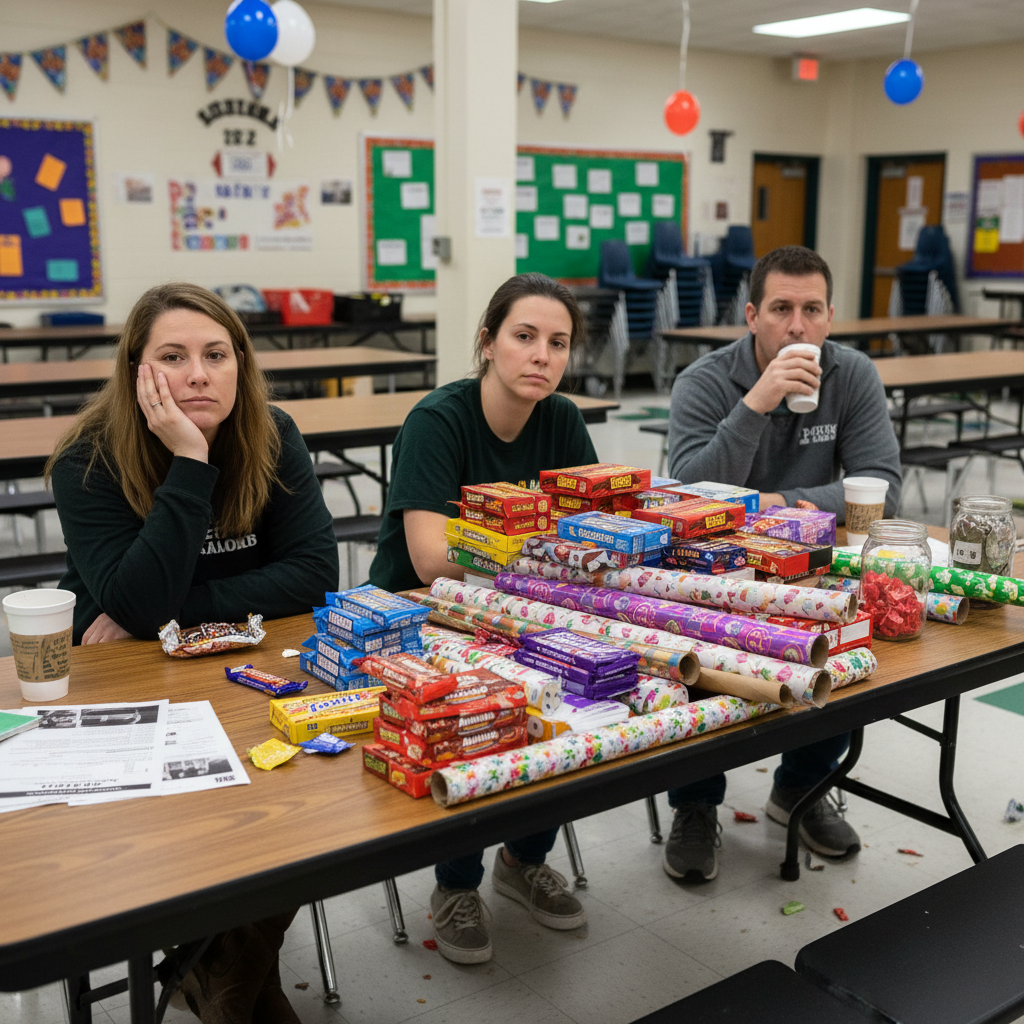
This is the classic school fundraiser. You buy products at wholesale prices and sell at a markup.
How it works:
- Purchase candy, popcorn, cookie dough, or similar products
- Students sell to family, friends, and neighbors
- Collect orders and distribute products
The numbers:
| Factor | Typical Range |
|---|---|
| Gross markup | 30–50% |
| Net profit | 20–40% of sales |
| Minimum order requirements | Usually yes |
| Upfront cost | $500–3,000 |
Real-world example: A booster club buys $2,000 worth of candy bars at $0.50 each, sells them at $1.00, and nets approximately $1,000. But this requires storing products, distributing to students, collecting money, and handling inventory.
Drawbacks:
- Students hate selling door-to-door
- Competition from stores and online shopping
- Inventory management and storage
- Unsold product becomes waste
- Short selling windows tied to campaigns
Car Washes and Events
Community events bring people together and create visibility, but the labor intensity is significant.
How it works:
- Organize volunteer car wash, pancake breakfast, or similar event
- Collect fees from participants
- Deduct event costs
The numbers:
| Factor | Typical Range |
|---|---|
| Revenue per event | $500–3,000 |
| Upfront costs | $100–500 |
| Volunteer hours | 20–80 hours per event |
| Net margin | 40–70% |
Real-world example: A car wash generates $1,500 in revenue, costs $400 in supplies and permits, and requires 40 volunteer hours. Net: $1,100, or about $27.50 per volunteer hour.
Drawbacks:
- Weather dependent
- Significant volunteer coordination
- One-time revenue spike, then nothing
- Same families volunteer every time
Direct Donation Campaigns
Asking for money directly. Often the highest-margin approach, but also the hardest to scale.
How it works:
- Email, mail, or in-person appeals for donations
- No product or event costs
The numbers:
| Factor | Typical Range |
|---|---|
| Response rate | 5–15% of families |
| Average donation | $25–100 |
| Upfront cost | Low (marketing materials) |
| Net margin | 80–95% |
Drawbacks:
- Many families don’t respond
- Can feel pushy to some parents
- Competition from other donation requests
- No tangible exchange for the donation
Merchandise Fundraising
This is where a fundraising partner like Varsity Vault comes in. Instead of buying inventory and selling products, you offer custom school merchandise through a partner who handles everything from design to shipping. You don’t handle products or inventory.
How it works:
- Create an online school spirit store
- Customers browse and purchase items
- Products print on demand and ship directly
- Your booster club receives a commission on each sale
The numbers:
| Factor | Typical Range |
|---|---|
| Commission rate | 10–20% |
| Average order value | $35–60 |
| Upfront cost | $0 |
| Inventory risk | None |
| Fulfillment time | 5–7 days |
Real-world example: A school store generates $5,000 in monthly sales at 15% commission. Net revenue: $750 per month with zero inventory handling or volunteer coordination.
ROI Comparison
Here’s how the major approaches compare on key metrics:
| Fundraiser Type | Net Margin | Time Investment | Upfront Cost | Scalability |
|---|---|---|---|---|
| Candy/food sales | 20–40% | High | $500–3,000 | Low |
| Car washes | 40–70% | Very high | $100–500 | Low |
| Direct donations | 80–95% | Medium | Low | Medium |
| Spirit merchandise | 10–20% commission | Very low | $0 | High |
Wait, the margin looks lower for merchandise. That’s the key insight. The raw margin percentage doesn’t tell the whole story. The actual net dollars per hour of volunteer time is what matters.
True ROI: Dollars Per Volunteer Hour
This is where merchandise fundraising separates itself:
| Fundraiser Type | Net Revenue | Volunteer Hours | $/Hour |
|---|---|---|---|
| Candy (typical) | $1,000 | 40 | $25.00 |
| Car wash | $1,100 | 40 | $27.50 |
| Direct donation campaign | $2,000 | 30 | $66.67 |
| Merchandise (passive) | $750/month | 2 | $375/hour |
Once your online store is set up, it generates revenue with minimal ongoing effort. You’re not trading hours for dollars anymore. The store works while you focus on other priorities.
Why Traditional Fundraisers Struggle
Several factors have eroded the effectiveness of traditional school fundraisers:
Consumer behavior shift: Parents buy everything online now. The door-to-door candy seller feels outdated. Kids today have never seen someone sell candy door-to-door, so they have no framework for how to do it.
Competition: Every other school does the same fundraisers. Parents are tired of being asked to buy the same products. The market is saturated.
Volunteer fatigue: The same 3–5 families do everything. Traditional fundraisers require intensive coordination that burns out organizers. According to the National PTA’s fundraising resources, volunteer burnout is one of the top reasons school fundraising programs stall.
Time poverty: Families are busier than ever. Finding time to sell products or work events is harder. The ease of online shopping contrasts sharply with old-school selling.
No passive revenue: Traditional fundraisers require active effort for every dollar earned. There’s no residual income or automatic sales.
Why Merchandise Fundraising Wins
Merchandise-based fundraising through a fundraising partner like Varsity Vault addresses every weakness of traditional approaches:
Zero inventory risk — You never buy products upfront. Everything prints on demand.
Passive revenue — Set up the store once, and it generates sales continuously. No campaign windows or selling deadlines.
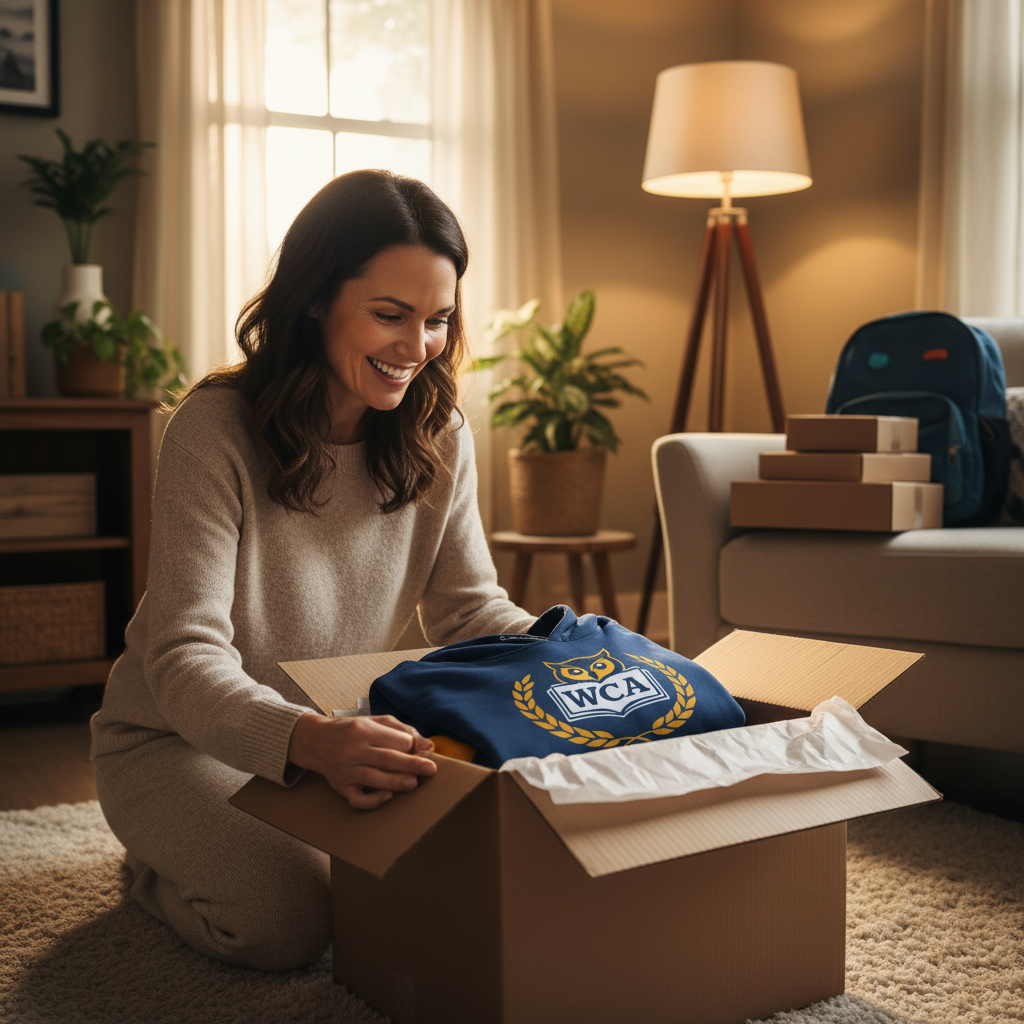
Professional fulfillment — The platform handles printing, packaging, and shipping. You’re not storing boxes in your garage.
Scalable — $5,000 or $50,000 in sales requires the same volunteer effort. Traditional fundraisers scale linearly with time invested.
Modern customer experience — Parents expect to buy things online. Meeting them where they already shop increases conversion.
Ongoing visibility — Every time someone wears a school hoodie or puts a decal on their car, it promotes your program. Traditional products get consumed or discarded.
When Traditional Fundraising Still Makes Sense
This isn’t to say you should completely eliminate traditional approaches. They still work in specific situations:
- Kickoff events — Car washes and community events build excitement and visibility at the start of a season
- Direct ask campaigns — Annual giving campaigns work for major donors and foundational supporters
- Small-scale efforts — Class or team-specific fundraisers may not need the merchandise infrastructure
The smartest approach combines passive merchandise revenue with strategic traditional events.
The Hybrid Approach
The highest-performing athletic programs use both:
- Always-on merchandise store — Generates passive revenue 24/7, 365 days a year
- Strategic events — One or two major events per year for community building and major fundraising
- Direct campaigns — Periodic donation appeals for specific needs (equipment, travel, facility improvements)
This creates multiple revenue streams without overloading volunteers. The merchandise store carries the baseline, while events and campaigns provide additional boosts. The Association of Fundraising Distributors & Suppliers reports that programs combining multiple channels see the highest sustained returns.
Making the Switch
If you’re ready to add merchandise fundraising to your mix:
- Start simple — Choose 10–15 products to launch with
- Promote consistently — Share the store link in every communication channel
- Build momentum — Feature new products seasonally
- Track results — Monitor sales and adjust offerings based on what sells
As your fundraising partner, Varsity Vault makes this easy with zero upfront costs, no inventory requirements, and 10–20% commission on every sale. Explore their product catalog to see what’s available for your school, and visit Varsity Vault bulk orders for information on bulk ordering options that complement your online store.
Why Having a Partner Beats Going It Alone
The biggest hidden cost in school fundraising isn’t products or permits — it’s the operational burden that falls on a handful of volunteers. When you run a traditional fundraiser, someone has to source products, negotiate pricing, manage inventory, collect payments, handle distribution, and deal with unsold items. That’s a part-time job nobody signed up for.
A fundraising partner changes the equation entirely. Instead of your booster club absorbing all the risk — fronting money for inventory, hoping products sell, storing boxes in someone’s garage — your partner takes on that risk. They invest in the production, fulfillment, and customer service infrastructure so you don’t have to. If a design doesn’t resonate, you haven’t lost a dime. If demand spikes, you don’t scramble to reorder. The partner absorbs the downside and enables the upside.
The logistics alone justify the partnership. Design, printing, packaging, shipping, customer inquiries, returns — all handled. Your volunteers stop being warehouse managers and order processors. They go back to being advocates: sharing the store link at games, posting on social media, and getting the word out. That’s the work that actually drives sales, and it’s the work your team is best at.
The result is a fundraiser that scales without strain. Whether your store does $2,000 or $20,000 in sales this season, the volunteer effort stays roughly the same. A partner model means you’re no longer trading hours for dollars — you’re leveraging a system built to handle volume so your organization can grow its revenue without growing its workload. As The Chronicle of Philanthropy consistently reports, sustainable giving models outperform one-off campaigns over time.
The math is clear. When you compare true ROI including time investment, merchandise fundraising delivers significantly better returns for most school athletic programs. Learn more about the Varsity Vault team and how their partnership model works.
Frequently Asked Questions
What is the ROI of merchandise fundraising compared to traditional school fundraisers?
Merchandise fundraising through a partner like Varsity Vault typically delivers $375 per volunteer hour compared to $25–$67 per hour for traditional fundraisers like candy sales, car washes, or direct donation campaigns. The key difference is that merchandise stores generate passive revenue with minimal ongoing effort, while traditional fundraisers require constant volunteer time for every dollar earned.
Is merchandise fundraising better than candy sales for schools?
For most school programs, yes. Candy sales typically net 20–40% profit with high upfront costs ($500–$3,000) and significant volunteer hours for distribution and collection. Merchandise fundraising has zero upfront cost, no inventory risk, and generates passive income. While the commission rate (10–20%) is lower than candy markup, the dollars-per-volunteer-hour are dramatically higher because the store runs continuously without manual effort.
How does a school merchandise fundraising store work?
A school merchandise store works through a partnership model. Your school or booster club works with a fundraising partner like Varsity Vault to create a custom online spirit store. Customers browse and purchase items directly. Products are printed on demand and shipped to buyers — your organization never handles inventory. Your booster club earns a commission (typically 10–20%) on every sale with zero upfront investment.
Can schools combine merchandise fundraising with traditional fundraisers?
Absolutely — and the highest-performing programs do exactly that. A hybrid approach uses an always-on merchandise store for baseline passive revenue, supplemented by one or two strategic events per year for community building, and periodic direct donation campaigns for specific needs like equipment or travel. This creates multiple revenue streams without overloading volunteers.
What are the hidden costs of traditional school fundraising?
The biggest hidden cost is the operational burden on volunteers. Someone has to source products, negotiate pricing, manage inventory, collect payments, handle distribution, and deal with unsold items. There’s also the financial risk of upfront inventory purchases — if products don’t sell, your organization absorbs the loss. Traditional fundraisers also have no passive revenue component, meaning every dollar requires active effort to earn.
How much can a school earn with a Varsity Vault merchandise store?
Earnings depend on your school’s size and engagement, but a typical school store generating $5,000 in monthly sales at a 15% commission earns $750 per month — or $9,000 per year — with minimal volunteer effort. Because the store runs passively year-round, this revenue accumulates without the campaign windows and volunteer burnout that limit traditional fundraisers. Larger programs with higher engagement can earn significantly more.