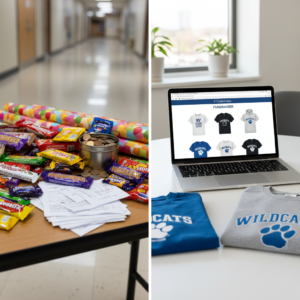
If you have ever coordinated a school fundraiser, you already know the drill. You spend weeks organizing. You recruit volunteers who are already stretched thin. You push product that nobody really wants. And when the money finally comes in, you look at the total and wonder whether it was worth the effort.
Here is the thing most people do not realize: the problem is not your volunteers, your community, or your effort. The problem is the fundraising model itself.
Candy bars, wrapping paper, car washes, bake sales — these have been the default for decades. They work just well enough to keep people coming back, but not well enough to actually fund the programs that need them. In 2026, a growing number of school organizations are replacing that entire cycle with something that raises more money, demands less labor, and runs on autopilot once it is set up.
That something is a school spirit store.
Not a store you build yourself. Not a store you stock with inventory. A store that exists as a fundraising vehicle — designed to generate revenue for your program while someone else handles the design, production, fulfillment, and shipping.
This is not a guide about how to set up a website. This is a guide about how to use a school spirit store as a fundraising tool, why it outperforms traditional methods, and how the right partnership model makes it possible with zero financial risk.
Why Traditional Fundraisers Are Dying
Let’s start with the honest math on the fundraisers most schools still rely on.
Candy and snack sales. Your group buys candy at wholesale, sells it at a markup, and keeps the difference. Typical profit margins sit around 40 to 50 percent. Sounds reasonable until you account for the reality: you need to buy inventory upfront, store it somewhere, manage cash handling, and depend on kids or volunteers to actually sell it. Unsold product eats your margins. Stolen cash eats your totals. And the whole process runs on volunteer hours that could be going toward your actual program.
Wrapping paper and catalog sales. These promise margins of 40 to 50 percent too, but the delivery timeline is usually four to six weeks. By the time the product arrives, the excitement is gone and so is the buyer’s motivation to order again. According to the National PTA, parent fatigue with catalog fundraisers is at an all-time high.
Car washes and bake sales. These are the most labor-intensive fundraisers per dollar raised. A Saturday car wash might bring in $300 to $500, but it requires 15 to 20 volunteers, supplies, a location, and good weather. When you divide the revenue by the hours invested, you are looking at something close to minimum wage.
The common thread across all of these: high effort, low predictability, and a hard ceiling on how much you can realistically raise. As the National Federation of State High School Associations has documented, school activity programs continue to face funding shortfalls even as fundraising efforts increase.
This is not a critique of anyone’s effort. It is a critique of the system. When your fundraising model requires you to spend more time selling than supporting your program, something is broken.
What a Spirit Store Fundraiser Actually Looks Like
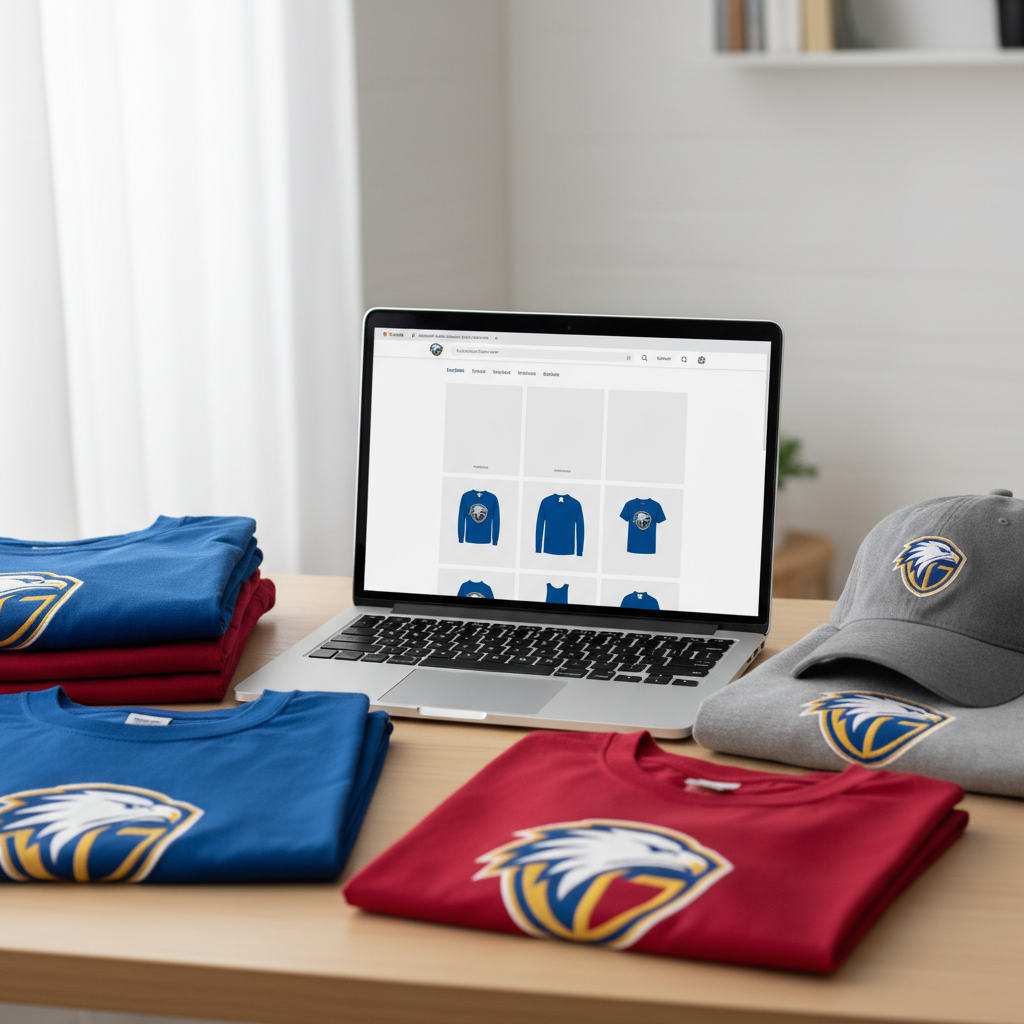
A school spirit store fundraiser flips the traditional model on its head. Instead of selling random products that have nothing to do with your school, you are selling something your community already wants: gear that represents their identity.
Here is how it works in practice.
Your organization partners with a company that handles the entire merchandise operation. They design the products, build the online store, produce each item on demand, and ship directly to the buyer. You never touch inventory. You never sort orders. You never chase down payments.
Your role? You promote the store to your community. That is it.
Every time someone makes a purchase, your organization earns a commission — typically 10 to 20 percent of the sale. The store stays open year-round, but you can also run it in focused campaign windows to create urgency and drive bursts of revenue. Learn more about how the process works.
This is fundamentally different from the old approach of ordering 200 shirts and hoping they sell. It is a model built on zero risk, zero inventory, and zero fulfillment labor — and it generates consistent, predictable income for your program.
The Fundraiser Partnership Model: Why It Changes Everything
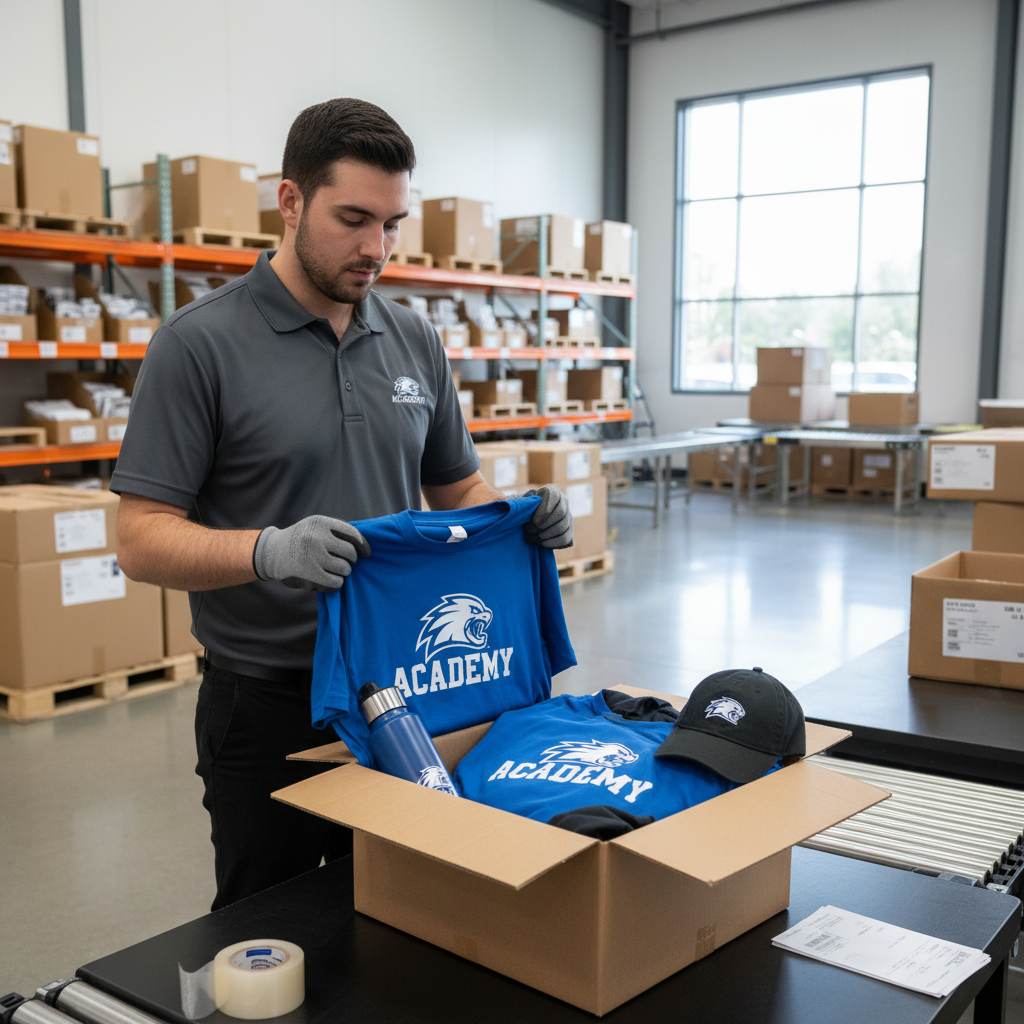
The most important shift in school spirit stores over the past two years is the move toward a partnership model. Instead of schools or booster clubs running their own stores — handling design, inventory, shipping, and customer service — they partner with a company that manages all of it.
This matters more than most people realize.
When a booster club tries to run its own merchandise operation, it usually goes something like this. Someone volunteers to handle the store. That person gets busy. Orders slip through the cracks. Customers complain. The volunteer burns out. The store goes dormant until someone new steps up. The cycle repeats.
A partnership model eliminates that dependency. The partner company — the one providing the store — handles every operational detail. Your organization promotes the store and collects commissions. That division of labor is what makes the model sustainable year after year.
How Varsity Vault Fits In
Varsity Vault operates on exactly this model. Organizations that partner with them get a fully managed spirit store: custom designs, on-demand production, direct-to-door shipping, and a commission on every sale. The organization never buys inventory, never packs a box, and never deals with returns.
The key insight here is that your organization’s competitive advantage is not merchandise logistics — it is community access. A partnership model lets you focus entirely on what you do best: engaging your supporters and driving traffic to the store.
The Real Math: Why Zero Risk Beats Higher Margins
One of the most common objections to the commission-based model is the margin. If a traditional candy sale gives you 50 percent and a spirit store gives you 10 to 20 percent, the candy sale looks like the better deal on paper.
But on-paper margins are misleading. Here is why.
Traditional model with inventory risk. Let’s say your booster club decides to sell custom t-shirts. You order 200 shirts at $8 each — a $1,600 upfront investment. You price them at $20. On paper, that is a $12 margin per shirt and a potential profit of $2,400.
Now reality hits. You sell 140 shirts. Thirty remain in wrong sizes that nobody wants. Ten have minor print defects that the supplier will not replace because you approved the proof. Five get lost or damaged during distribution. You have 15 unsold shirts and a box of inventory sitting in someone’s garage.
Your actual revenue is $2,800. Your actual cost is $1,600. Your actual profit is $1,200 — not $2,400. Your effective margin is closer to 43 percent — and that does not account for the value of the volunteer hours spent sorting, distributing, and chasing down payments.
Partnership model with zero risk. Now run the same scenario with a commission-based spirit store. Your community buys 140 shirts at $20 each. At a 15 percent commission, your organization earns $420.
Wait — $420 versus $1,200? That seems like a clear loss. But you are missing three critical factors.
First, the commission model typically supports higher price points and more product variety, which drives more total sales. Your community is not limited to one t-shirt design. They can choose from hoodies, hats, bags, and more — all without you ordering a single item upfront.
Second, you can run the store year-round with zero additional effort. That $420 from a single campaign becomes $420 times three or four campaigns per year — or more, if the store is always open. Need gear for a big event? Use the bulk order option alongside your store.
Third — and this is the one nobody quantifies — you invested zero dollars and zero hours of fulfillment labor. Every dollar of commission is pure net revenue. No inventory losses. No volunteer burnout. No garage full of unsold merchandise.
When you account for all of these factors, the annual return from a commission-based spirit store regularly exceeds what traditional inventory models produce — with a fraction of the effort and none of the risk.
How to Maximize Your Spirit Store Fundraiser
The store itself is the vehicle. Promotion is the engine. Here is how to get the most out of a spirit store fundraiser.
Run focused campaigns, not just an always-on store. An always-on store is great for passive income, but the real money comes from campaign windows. Open the store for two to three weeks, promote it hard, then close it. Scarcity drives action. You can run multiple campaigns throughout the year — one for each season or event.
Tie campaigns to events and milestones. Homecoming week, senior night, the start of football season, graduation — these are moments when school spirit is naturally at its peak. Align your store campaigns with these events and you will see significantly higher engagement.
Use every channel you have. Email lists, social media accounts, team group chats, school newsletters, morning announcements — every touchpoint is a promotional opportunity. The organizations that raise the most are the ones that communicate consistently across multiple channels. As Edutopia notes, parent engagement is the single biggest predictor of fundraising success.
Make it about the cause, not just the product. People buy spirit wear because they want to show support. Remind them what their purchase funds — new uniforms, travel expenses, equipment upgrades. When buyers understand the impact, they buy more and they share the store with others.
Refresh designs regularly. Even the most loyal buyers will not purchase the same design twice. Work with your partner to release new designs for each campaign. Fresh artwork keeps the store feeling new and gives past buyers a reason to come back.
This Is Not Just for Athletic Departments
One of the biggest misconceptions about spirit stores is that they only work for sports teams. In reality, any organization with a committed community can run a successful spirit store fundraiser.
PTO and PTA organizations are some of the most active users of commission-based spirit stores. Parents want to support their kids’ school, and spirit wear gives them a tangible way to do it — without the logistical nightmare of a traditional fundraiser.
Band and music programs have deeply committed communities. Band parents, alumni, and supporters are often more engaged than athletic boosters, and they respond strongly to branded merchandise that celebrates their program.
Academic teams and clubs — debate, robotics, theater, language clubs — all have their own identity and their own community. A spirit store lets them raise funds without diverting time from the activity itself.
Booster clubs that support multiple teams or programs can run a unified store with collections for each group. This creates a single destination for the entire school community while tracking commissions separately for each program.
The point is that spirit store fundraising works wherever there is a community that identifies with a school, team, or program. If your group has supporters, it can have a spirit store.
What to Look for in a Fundraising Partner
Not all spirit store providers are built for fundraising. Some are merchandise companies that happen to sell school gear. Others are fundraising platforms that tack on merchandise as an afterthought. The best partners are the ones built from the ground up to serve school organizations.
Here is what to look for when evaluating a partner.
Zero upfront cost. If you are paying to set up the store, you are taking on risk. A true fundraising partner should cover all setup costs and earn their money through the product margin — not by charging you before a single item sells.
On-demand production. The partner should produce items only after they are ordered. This eliminates inventory risk entirely. If a partner asks you to commit to minimum order quantities, they are not offering a true zero-risk model.
Direct-to-buyer shipping. You should not be responsible for sorting, packing, or distributing orders. The partner should ship every order directly to the person who bought it. This removes your biggest operational burden.
Commission transparency. You should know exactly what percentage you earn on each sale before you sign up. No hidden fees, no complicated pricing tiers, no surprises.
Design support. If you have talented designers in your organization, great. But you should not need them. A good partner provides professional design support as part of the package.
Responsive communication. When you have a question or a buyer has an issue, you need a partner who responds quickly. Test their responsiveness before you commit.
Varsity Vault checks all of these boxes — zero upfront cost, on-demand production, direct shipping, transparent commissions, design support, and responsive communication. That is why school organizations across the country are choosing the partnership model over the old DIY approach.
The Bottom Line
School spirit stores are not a new idea. But using them as a dedicated fundraising vehicle — with a partnership model that eliminates risk, inventory, and fulfillment labor — is the approach that is reshaping school fundraising in 2026.
It works because it aligns incentives. Your community gets products they actually want. Your organization gets revenue without the operational burden. And your volunteers get their time back — which means they can focus on the program instead of the fundraiser.
If you are still running candy sales and car washes, you are not wrong for trying. You are just working with a model that was designed for a different era. There is a better way, and it starts with a conversation.
To learn more about how a partnership-based spirit store fundraiser works, visit varsityvault.io/#aboutus or see how it works.
Frequently Asked Questions
How does a school spirit store fundraiser work?
Your organization partners with a company like Varsity Vault that builds and manages an online spirit store for your school. They handle design, production, and shipping. You promote the store to your community, and every purchase earns your organization a commission — typically 10 to 20 percent. You never buy inventory or pack orders.
Is there any upfront cost to start a spirit store?
No. With a true partnership model like Varsity Vault’s, there are zero upfront costs. The partner company covers store setup, design, and production. Your organization takes on no financial risk whatsoever — you only earn commissions on sales.
How much money can a school spirit store raise?
Results vary based on school size and community engagement, but commission-based spirit stores typically generate consistent revenue through multiple campaigns per year. Because the store runs year-round with no inventory cost, every dollar of commission is pure net revenue for your organization.
Can non-athletic organizations use a spirit store fundraiser?
Absolutely. PTA and PTO groups, band and music programs, academic clubs, theater departments, and booster clubs all run successful spirit store fundraisers. Any organization with a community that identifies with the group can benefit.
What products are available in a school spirit store?
Most spirit stores offer a wide range of custom merchandise including t-shirts, hoodies, hats, bags, and accessories. Because items are produced on demand, you can offer dozens of product options without ordering inventory upfront. Many partners also offer bulk ordering for events.
How is a spirit store different from ordering shirts in bulk?
Bulk ordering requires upfront payment, inventory management, size sorting, and distribution — all handled by your volunteers. A spirit store eliminates all of that. Products are made on demand, shipped directly to buyers, and your organization earns a commission with zero operational burden.